A Montana man recently fought back after police entered his home without a warrant, and the US Supreme Court sided with him. In Case v. Montana (Jan. 14, 2026), the court ruled that warrantless home entry is presumptively illegal unless a clear exception applies, so evidence from that entry was thrown out.
If you’ve ever felt brushed off by an authority, this matters. When you don’t know your basic rights as a citizen, unfair treatment can look like “just how it works,” even when the Constitution sets limits. And once you do know the basics, you can speak up with more confidence, ask the right questions, and protect your side in real time.
These rights come up in everyday moments, not just court dramas. You’ll see how the First Amendment protects speech and protest, the Fourth Amendment covers privacy and searches, and the Sixth Amendment supports fair court procedures. You’ll also learn about other key protections that keep government officials from acting without boundaries.
Most importantly, these rules help put a check on power, so your voice and your safety don’t depend on luck. Next, let’s start with the first rights many people run into: the protections tied to speech, expression, and public participation.
Master Your First Amendment Freedoms: Speech, Religion, Press, and Assembly
The First Amendment is short, but it does a lot. It helps protect your freedom of speech rights, your right to practice religion, and your right to share ideas and organize with others. Think of it like a set of guardrails that keep government power from squashing your voice. At the same time, it recognizes there are limits when speech turns into real harm.
Speak Your Mind Without Government Interference
Freedom of speech means the government can’t silence your ideas just because they disagree with you. You can speak up in person, write blogs, debate issues, and post opinions online. For example, a student protest, a community meeting comment, or a strong post on social media can all fall under freedom of speech rights.
That said, speech isn’t unlimited. Courts recognize limits for threats, harassment that targets specific people, and certain categories of expression that cause direct harm. Also, government can regulate the time, place, and manner of speech, as long as it stays fair and content-neutral.
Ever wondered why you can criticize leaders? The First Amendment protects that, even when the criticism is uncomfortable. It matters for democracy because speech lets people argue, share facts, and expose problems before power hardens.
For a plain-language breakdown of what the First Amendment covers, see What the First Amendment Really Protects.

Courts also treat online speech seriously. In practice, that means your right to post and respond is often judged much like your right to speak in public, depending on the situation.
Choose and Practice Your Religion Freely
The First Amendment has two religion parts. First, it stops the government from setting up an official religion (no establishment). Second, it protects your ability to practice your faith (free exercise). In plain terms, the government can’t force you into a belief, and it also can’t usually block your religious practice without a strong reason.
In everyday life, free exercise can show up in choices like wearing religious symbols at school or work, making space for prayer, or observing certain faith rules. Still, courts look closely at how a religious practice affects safety, public order, or other legal duties.
Recent cases have shaped this area through the lens of schools and families. For example, in Mirabelii v. Bonta (March 2, 2026), the Court acted on issues tied to parents and teachers who claimed certain California policies interfered with free exercise. The takeaway is simple: religion rights don’t vanish when laws get complicated.
Publish News and Opinions Through the Press
The First Amendment protects a free press. That includes journalists, news outlets, and many people who publish information for public debate. You don’t need a newsroom badge to benefit from this idea. If you’re reporting, reviewing, or explaining events, you’re part of the public conversation that helps citizens make choices.
Today, this extends beyond newspapers. Blogs, local websites, and many independent social media posts function like “publishing” in the real world. Courts often ask whether the activity acts like press work, such as gathering information and sharing it with the public.
Of course, press freedom does not mean “no consequences.” People can still face legal limits for defamation, fraud, or other harmful conduct. But the baseline rule stays strong: government cannot broadly censor news just because it’s critical.
If you want a reliable overview of how speech limits work in general, Freedom of Speech: An Overview (Congressional Research Service) explains how courts treat the First Amendment as a real boundary, not a slogan.
Gather Peacefully and Petition for Change
The assembly and petition parts of the First Amendment protect your ability to come together and ask for change. That includes peaceful marches, rallies, and public meetings. It also includes contacting officials, writing letters, signing petitions, and seeking policy changes through lawful channels.
This right matters because change rarely happens in silence. When people organize, they show up as a group, and their message gains weight. Imagine it like a chorus instead of a single voice. The chorus still uses words, but it can be heard.
The limits usually focus on safety and order, not ideas. Governments can set rules about permits, crowd spacing, and time or location for events, as long as the rules do not target your viewpoint. Keep it peaceful, stay within posted rules, and document what happens.
When you petition, remember the goal is action, not chaos. A calm letter to a city council member or a well-run march can do more than anger, because it turns beliefs into requests people can answer.
Protect Your Home, Privacy, and Property from Unfair Government Actions
When you think about rights, homes and property usually come first. The Third Amendment limits quartering soldiers in your home, and the Fourth Amendment protects your privacy from unreasonable searches. Then the Fifth Amendment steps in when the government tries to charge you, question you, or take your property. Together, these rules help you feel secure, not stuck guessing what officials can do.
Demand Warrants Before Searches or Seizures
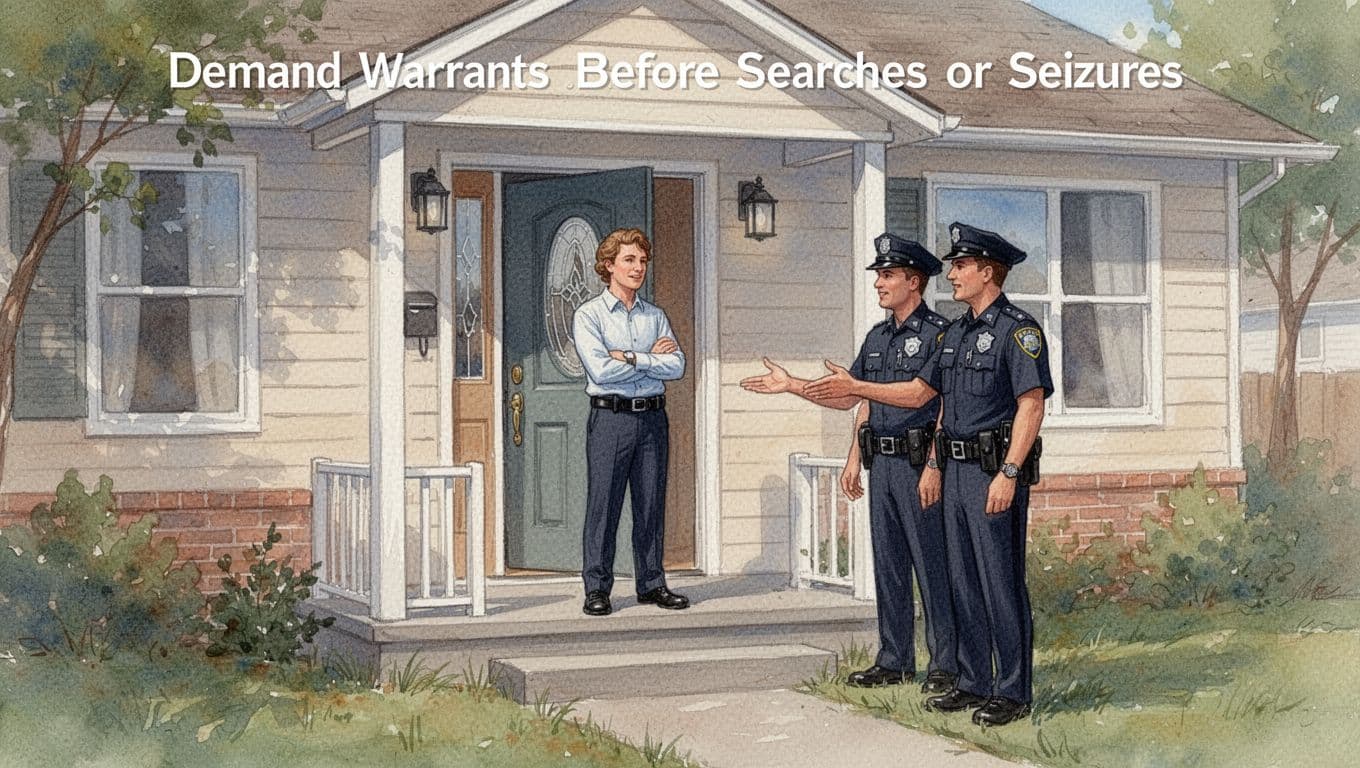
The Fourth Amendment protects your home, your “papers,” and your personal effects from unreasonable searches and seizures. In plain terms, police generally need a warrant before they enter your home or search for evidence.
That warrant requirement matters because it forces an outside check. A judge must find probable cause and make the search specific. The Constitution also requires the warrant to describe where to search and what to seize. For the exact constitutional text and a clear explanation, see Fourth Amendment warrant requirements.
Here’s a real-world way to picture it. Suppose police show up and ask to look through your phone or your bedroom for “anything illegal.” Without a warrant, they need a recognized legal exception. Otherwise, your privacy gets treated like it has no walls.
Phone searches show how the rule hits daily life. Police can’t just grab your phone because they’re curious. Instead, they usually need proper legal authority, and courts look closely at whether the search was justified at the start. If the situation turns into a lawful arrest, the rules change, but the government still has to follow limits.
Recent Supreme Court activity also shows why this topic stays current. As of late March 2026, the Court has focused on warrantless home entries under emergency-style exceptions, not on erasing the warrant rule. That means the core idea still stands: police need a strong reason and the right paperwork in most home-and-property cases. For a deeper guide to how courts analyze search and seizure issues, read unreasonable searches and seizures basics.
In the moment, keep it simple:
- Ask if they have a warrant before consenting to any search.
- Stay calm, stay quiet, and don’t physically interfere.
- If they claim an emergency, ask what specific danger or exception they’re relying on.
Insist on Fair Due Process in Legal Matters
The Fifth Amendment protects you in two big ways. First, it blocks unfair legal treatment like being tried twice for the same offense (no double jeopardy) and being forced to testify against yourself (self-incrimination). Second, it requires due process before the government can take your life, liberty, or property.
Think of due process like a traffic light for government power. You get a chance to be heard. The rules apply to officials too, not just to you. That matters when police, prosecutors, or regulators pressure you in fast-moving situations.
Self-incrimination is where many people get tripped up. During custodial questioning, officers generally must provide Miranda warnings before interrogation. Those warnings exist so you understand you can remain silent and ask for a lawyer. For an official explanation of Miranda requirements, see Miranda requirements.
Also, due process connects to property. If the government takes land or equipment for public use, it usually must follow fair procedures and provide just compensation. So if you get notice of seizure or condemnation, don’t assume it’s automatic or final. Timing, documentation, and hearing rights often make a difference.
When police talk to you, use practical steps:
- Say you want to stay silent and ask for a lawyer if you’re in custody.
- Don’t guess about facts they didn’t ask for.
- Document what you can safely remember after the interaction.
One more right matters here, even if you never hear it in court: the Ninth Amendment says you still keep rights not listed in the Constitution. In daily life, that means your protections don’t end just because a right isn’t named in a headline.
Secure Fair Treatment in Court and Avoid Cruel Punishments
Fair trials are not just a slogan. When courts move fast, stay public, and follow strict rules, the system catches mistakes before they harden into injustice.
In criminal cases, the Sixth Amendment acts like a set of guardrails for your defense. Meanwhile, the Seventh Amendment protects jury trials in certain civil disputes. Then the Eighth Amendment steps in to stop punishments that go too far.
This matters because a case can feel hopeless when you lose control of the process. These rights give you a voice in the courtroom, not just a role in paperwork.
Get a Speedy, Public Trial with a Jury
The Sixth Amendment protects people facing criminal charges. It includes the right to a speedy and public trial, an impartial jury, and the assistance of counsel. It also includes the right to know the accusation and to face witnesses in a real, meaningful way.
Speedy trial rights help prevent “limbo justice.” Evidence can fade, witnesses can forget, and memories can change with time. When delay stretches, the risk of a bad outcome grows. Courts use a balancing test instead of a single deadline, so the key question becomes whether the delay harms fairness.
Public trials also protect you and the community. Openness discourages shady deals. It also lets observers see that the judge and lawyers follow the rules.
A jury trial protects facts from being decided behind closed doors. Your peers serve as a reality check. They also reduce the odds of bias that can creep into a case when one person holds too much power.
Here are the core pieces the Sixth Amendment usually protects in a criminal case:
- Public trial: proceedings happen openly, with limited exceptions.
- Speedy trial: courts weigh delay, reasons, your demands, and prejudice.
- Impartial jury: jurors must decide based on evidence, not guesswork.
- Right to counsel: a lawyer helps you respond, object, and defend.
- Confrontation: you can challenge witnesses against you.
For a plain-text view of what the Sixth Amendment covers, see the Sixth Amendment text and explanation.
Meanwhile, the Seventh Amendment matters in federal civil cases. If a dispute involves “suits at common law,” you often get a jury to decide disputed facts. For a clear explanation of how this works in civil matters, check the Seventh Amendment jury right overview.
Escape Excessive Bail, Fines, and Unusual Punishments
The Eighth Amendment protects you from punishment that is too harsh. It covers excessive bail, excessive fines, and cruel and unusual punishments. Think of it as a brake pedal for the justice system. Punishment should fit the offense, not crush you beyond reason.
Let’s start with bail. If you face pretrial detention, courts still have limits. Bail should not operate as a punishment before guilt is decided. When bail becomes so high that it turns into a penalty, the Eighth Amendment can apply.
Next are fines. Excessive fines can drain someone’s life savings, even when a case ends with reduced or disputed culpability. A strong example is Timbs v. Indiana (2019). In that case, the Supreme Court held that the Eighth Amendment’s protection against excessive fines applies to states. That meant a state could not dodge the limits by putting the fine system under state control. For the decision itself, see Timbs v. Indiana (Supreme Court opinion).
Finally, “cruel and unusual punishments” sets a moral and legal boundary. Cruel punishment is not only about pain. Courts also look at whether the punishment is out of step with human dignity, proportionality, and established standards.
These protections prevent miscarriages of justice in a few key ways:
- Less pretrial coercion: bail pressure cannot force you into a bad deal.
- More proportional outcomes: fines and penalties must match the law’s goals.
- Lower risk of extremes: punishment cannot become revenge in a robe.
Here’s a simple way to remember the Eighth Amendment in real life: when the state punishes you, it must stay within limits. The Constitution does not allow “too much” just because the government wants it.
Claim Your Right to Vote, Bear Arms, and More Everyday Protections
Rights only matter when you use them. So think of this section as a daily toolkit. It covers how voting protections work, what “bear arms” means in real life, and how the Tenth Amendment limits who gets to make which rules.
Exercise Your Power at the Ballot Box
Voting is not a “maybe” right. In the US, the Constitution stops states from denying voting access for certain reasons. It also sets baseline rules that most states follow, even though states control many details.
In general, you can vote if you are a US citizen, 18 by Election Day, and you meet your state’s residency rules. Then you register, and you follow the state’s election rules for your polling place or mail ballot.
If someone tries to stop you, ask a simple question: “What law and what deadline are you relying on?” Denial can happen through delays, confusing rules, or outright obstruction. Your best response is calm, documented, and practical.
Common ways people exercise the right in everyday life include:
- Registering to vote early (especially if you move often)
- Updating your address after a change of residence
- Requesting a mail ballot if you need a flexible option
- Showing up at the right polling place on time (or using an approved early vote method)
Two major voting amendments focus on who cannot be blocked:
- The 15th Amendment bars denying the vote based on race.
- The 19th Amendment bars denying the vote based on sex.
- The 26th Amendment lowers the voting age to 18 for federal and many state elections.
For a clear guide to how voting rights rules developed, see the Constitution Center’s voting rights module.
Also remember what states still control. Rules on ID for voting, mail ballots, registration timing, and polling locations often vary. Therefore, check your state election office or vote site before Election Day.
Understand the Right to Bear Arms Responsibly
The Second Amendment protects the right to keep and carry arms. Courts also treat it as tied to lawful self-defense and public safety. At the same time, it is not a blank check.
A good way to understand the modern view is the Supreme Court’s Bruen approach. In New York State Rifle & Pistol Assn. v. Bruen, the Court explained how gun laws get judged and how lower courts analyze them. You can read the decision here: Bruen and the Second Amendment (SCOTUS opinion).
Practically, that means:
- Self-defense can be a major reason people carry firearms.
- Gun laws still exist, like rules about who can possess firearms and where carrying is allowed.
- Your state can set licensing rules, training rules, and carry rules, as long as they fit constitutional limits.
For example, many states require permits or impose limits on carrying in certain places. Others regulate forms of ownership, storage, or prohibited categories.
Finally, the Tenth Amendment matters in the background. It reserves many powers to the states for areas the federal government does not control. In disputes over guns, states often play a big role because they set day-to-day rules. If you want the plain meaning of “reserved powers,” see what the Tenth Amendment says.
Conclusion
Your basic rights as a citizen give you real limits on government power, and they show up in everyday moments, not just court cases. When you know your First Amendment speech rights, your Fourth Amendment privacy protections, and your Fifth and Sixth Amendment safeguards in legal trouble, you can respond with calm focus instead of confusion.
Because rights work best when you use them, keep this guide close. Bookmark it, then share it with someone who wants to speak up and stay protected, even when things feel tense.
What’s one right you want to learn more about next, and how will you use it the next time you need it? Stay grounded, stay informed, and live free with your rights in mind.